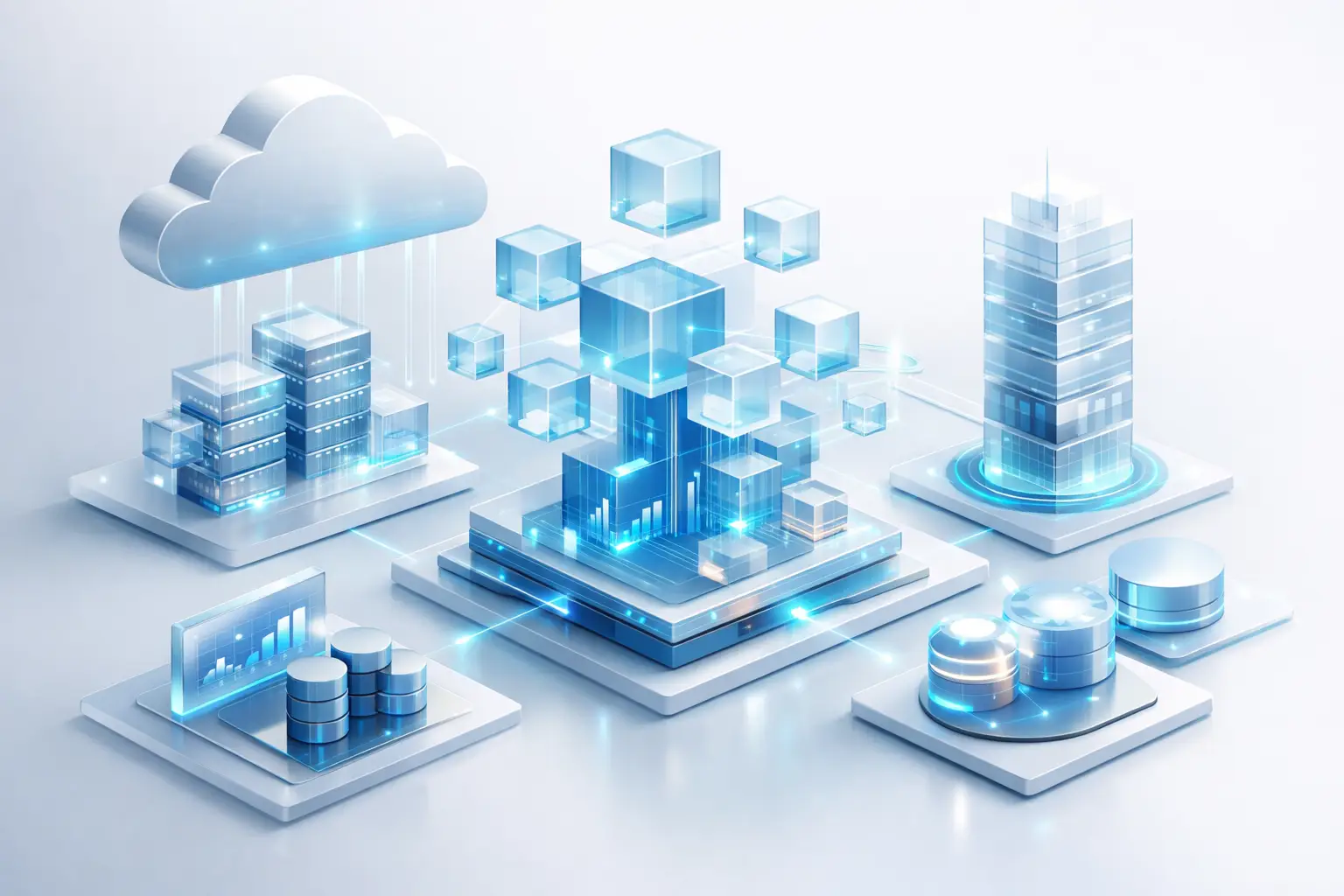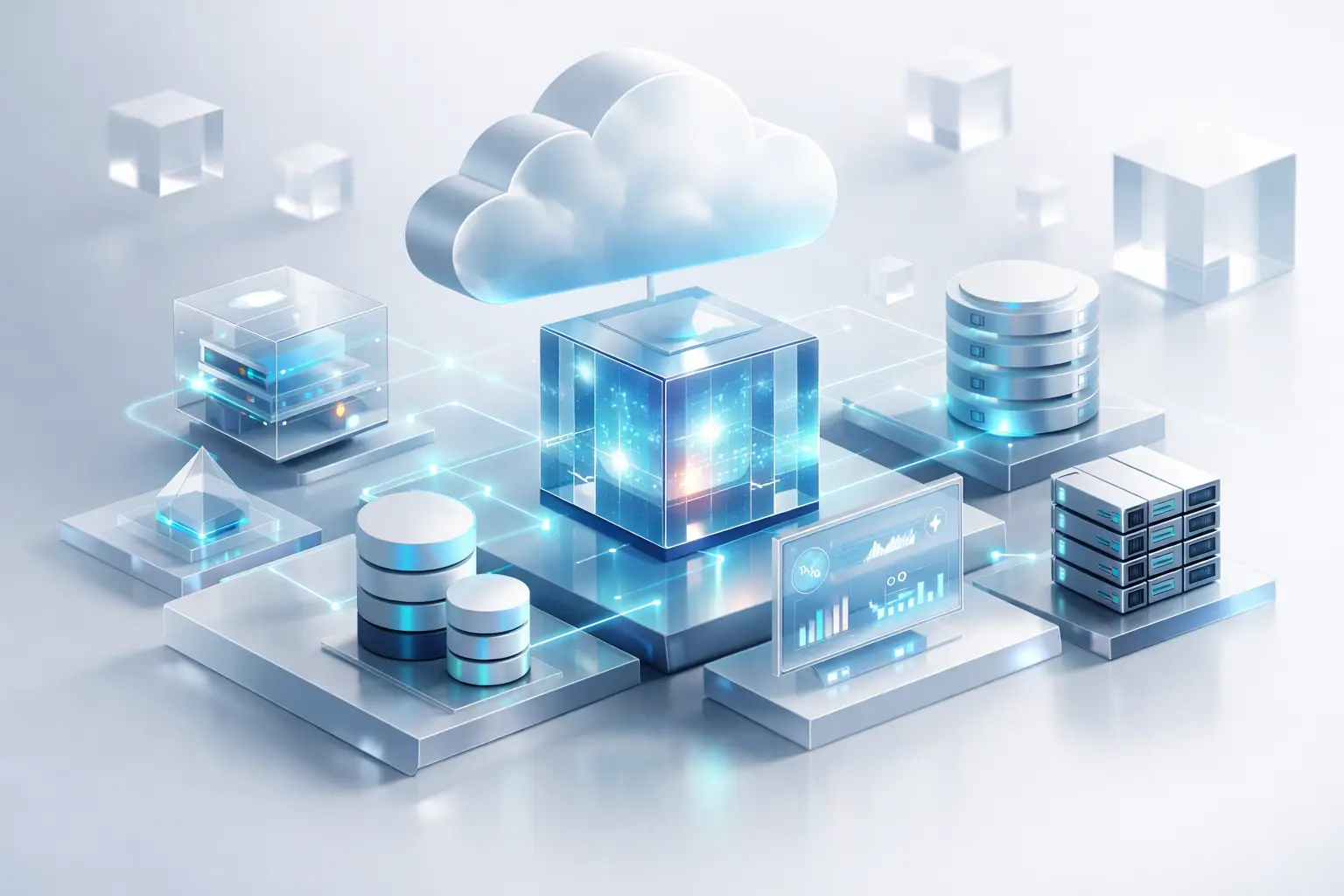
When the company grows, data rarely grows in an organized manner. It spreads across ERP, CRM, spreadsheets, APIs, legacy applications, and cloud platforms. The problem is not just technical. Without modern data architecture, operations lose speed, governance weakens, and critical decisions begin depending on rework, manual consolidations, and conflicting versions of information.
For technology and business leadership, this scenario tends to appear in familiar forms: dashboards that do not match, fragile integrations, poorly sized processing costs, difficulty applying AI safely, and teams consumed by operational tasks. Modern data architecture enters precisely to reorganize this foundation. Not as an end in itself, but as a model to transform dispersed data into analytical capacity, automation, and faster market response.
What defines modern data architecture
Modern data architecture is not a specific product, nor a pretty diagram for executive presentations. It is a set of principles, technologies, and practices for collecting, storing, processing, governing, and making data available with scale, flexibility, and control.
In practice, this means moving away from rigid, expensive-to-maintain, slow-to-evolve environments. Instead of concentrating everything in monolithic structures, the company starts operating with more elastic services, automated pipelines, well-defined ingestion and transformation layers, as well as consistent catalog, security, and observability mechanisms.
This design tends to combine data lake, data warehouse, batch and near-real-time processing, event-driven integrations, access policies, and analytical tools aimed at different user profiles. The central point is not adopting every piece available on the market. It is assembling a coherent architecture with maturity stage, regulatory requirements, and business pace.
Why the traditional model stops responding
For a long time, companies structured their data intelligence in centralized, low-flexibility environments. This worked better when there were fewer sources, lower volume, and more predictable analytical demand. Today, reality is different.
Business areas expect fast responses, systems produce data in different formats, and automation pressure has increased. At the same time, costs need to be controlled and security requirements have become more rigorous. In legacy architectures, any relevant change tends to be slow, expensive, and risky.
The effect appears in a chain. Data engineering spends energy correcting load failures. BI depends on manual extractions. The executive area loses confidence in indicators. And AI initiatives end up stagnant because data lacks adequate quality, traceability, or availability. In many cases, the problem attributed to analytics is actually in the architectural foundation.
The pillars of modern data architecture
A well-implemented modern data architecture starts from some clear pillars. The first is on-demand scalability. Infrastructure needs to grow or reduce according to consumption, avoiding both bottlenecks and oversizing.
The second is integration between heterogeneous sources. Medium and large companies operate with mixed ecosystems, including legacy applications, SaaS, transactional databases, and cloud services. Architecture needs to handle this without creating difficult-to-sustain dependencies.
The third is applied governance. It is not enough to store data. It is necessary to know where it came from, who can access it, how it was transformed, and which quality rules must be respected. Without this, analytical confidence deteriorates quickly.
There is also a fourth decisive point: readiness for advanced use cases. Machine Learning, operational forecasts, anomaly detection, and intelligent automations depend on a foundation capable of serving consistent data with low friction. The company that needs to rebuild everything before each AI initiative loses competitiveness.
Modern data architecture and business impact
The most visible gain tends to be speed. Reports stop depending on time-consuming consolidations, areas begin accessing more updated data, and operational decisions become less intuitive and more evidence-oriented.
But the most relevant effect, for many decision-makers, is efficiency. Modern architecture reduces redundancies, eliminates manual flows, and improves cloud service utilization. This helps control costs, reduce recurring failures, and free specialized teams for higher-value initiatives.
There is also direct impact on compliance and security. With centralized policies, audit trails, and access segmentation, the organization reduces exposure and gains predictability for meeting regulatory requirements. This point is especially critical in sectors with high volumes of sensitive data or distributed operations.
Another important benefit is the capacity to evolve without halting operations. A company does not need to wait for a large complete replacement project to start capturing value. When architecture is designed modularly, modernization occurs in stages, with progressive gains and more controlled risk.
What changes in data operations
The difference between a traditional environment and modern data architecture appears in daily life. Instead of opaque, difficult-to-maintain pipelines, the company begins working with more automated, monitored, and versioned flows. Instead of multiple uncontrolled copies, there are layers with defined purpose. Instead of depending only on specialists for any query, business users have more structured access to information.
This change also alters the relationship between IT and corporate areas. The technical team stops acting only as reactive support and assumes a more strategic role, creating a platform that accelerates analytics, integrations, and innovation initiatives. For leadership, this means transforming data into an operational asset, not just a report input.
Not every modern data architecture needs to be the same
This is a point that deserves care. There is a tendency to treat modern architecture as a fixed recipe. It is not. An industrial operation with heavy sensoring, for example, has different needs from a financial services company or an omnichannel retail network.
Volume, required latency, criticality level, regulatory profile, and team maturity completely change the choices. In some scenarios, it makes sense to prioritize real-time ingestion. In others, the greater gain comes from reorganizing the analytical layer and governance. There are cases where reducing complexity brings more value than expanding the number of tools.
Therefore, architectural decisions need to be guided by business objectives. If the goal is eliminating operational bottlenecks, the design should attack the friction point. If the focus is on scaling corporate AI, priority falls on data quality, catalog, security, and availability of reliable data for training and inference.
How to conduct modernization without increasing risk
The worst approach tends to be the most seductive on paper: trying to redesign everything at once. Overly broad projects generate delay, accumulated cost, and low adherence. Modernization works best when treated as a structured journey, with strategic vision and incremental deliveries.
The first step is mapping critical data flows and identifying where real bottlenecks are. The problem is not always in the current tool. Often it lies in poorly defined processes, improvised integrations, or absence of minimum governance.
Next, it is necessary to define a viable target architecture, compatible with the company's operational reality. This includes ingestion, transformation, storage, observability, security, and analytical consumption services. Cloud platforms tend to accelerate this process by offering elasticity and managed services, but technology choice must respect business constraints and technical requirements.
In execution, the ideal is starting with use cases with clear return. A critical pipeline, a reliable layer for executive indicators, or a structured base for automation can already demonstrate value and finance subsequent stages. This is how many companies began connecting strategy, engineering, and results — including in projects conducted by ST IT Cloud with focus on AWS, governance, and operational efficiency.
The role of cloud in this evolution
The cloud does not resolve architecture problems alone, but offers the most favorable environment for building a modern data operation. Elasticity, specialized services, infrastructure automation, and variable cost models allow evolving with more speed and control.
Still, migrating to cloud without redesigning processes merely transfers inefficiencies to a different location. If data remains disorganized, without catalog, without access policy, and without observability, the modern environment becomes just a more expensive version of the previous problem. Value appears when cloud is used to simplify, standardize, and scale what truly matters.
What a decision-maker should observe now
If your company already perceives that data is blocking operations, the discussion should not be whether it is worth modernizing, but where to start to generate concrete impact. The signals tend to be clear: excess manual work, low indicator confidence, difficulty integrating sources, unpredictable costs, and AI projects that never leave the pilot stage.
Modern data architecture is, in the end, a decision about execution capacity. It defines whether the organization will continue reacting to failures and patches or whether it will operate with a foundation prepared to grow, automate, and decide better. In markets increasingly pressured by efficiency, this difference appears quickly in results.