Artificial intelligence (AI) has ceased to be a distant promise and become the foundation of corporate innovation.
More than automating processes, it is redefining the concept of efficiency, connecting data, people, and technology in a structure capable of generating measurable results.
Companies that have understood this movement no longer see AI as an isolated investment, but as a strategic axis to scale operations, enhance customer experience, and accelerate decision-making.
According to the State of Generative AI in the Enterprise 2024 report by Deloitte, 58% of surveyed professionals state that increased innovation is the main perceived benefit of AI adoption.
This data reflects a significant shift: artificial intelligence is no longer an experimental tool, but a proven force for generating corporate value.
From automation to strategy: the role of AI applied to business
For years, the focus of AI applied to business was on automating repetitive tasks.
Today, the scenario is different. The evolution of language models, machine learning, and predictive analytics has allowed companies to move from simple automation to intelligent, data-driven decision-making.
In the corporate environment, this transition is clear. Service processes, supply chain, marketing, and even governance are being transformed by solutions that learn from user behavior and continuously optimize operations.
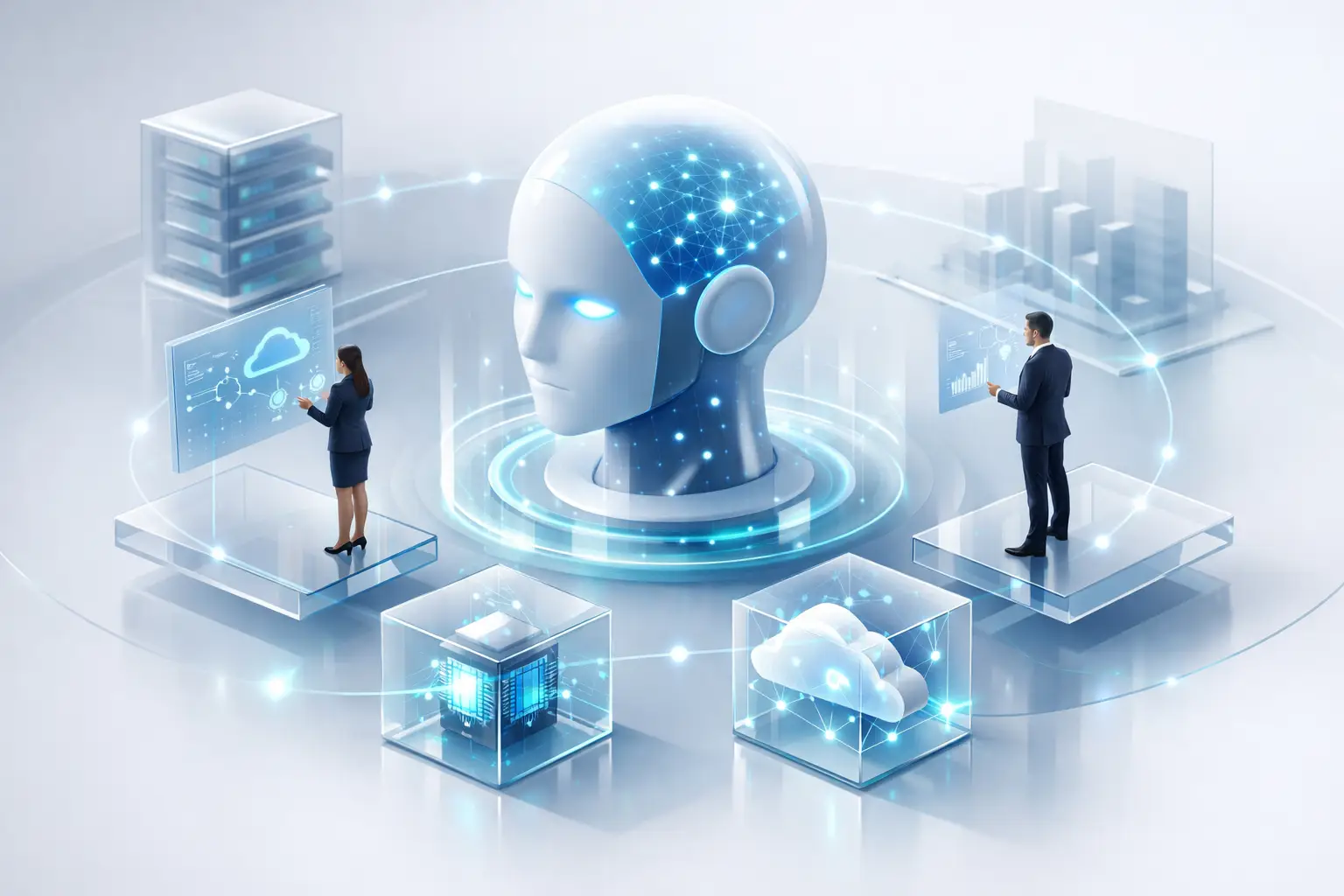
A practical example comes from the integration between AI and cloud computing, which enables large-scale processing and real-time data orchestration — one of the specialties of ST IT Cloud.
The company has been helping large organizations to incorporate artificial intelligence into AWS environments with security, governance, and scalability.
This approach goes beyond automation: it is AI as a strategic foundation to innovate efficiently, reducing costs and expanding return on investment (ROI).
Operational efficiency with AI: the impact that goes beyond the numbers
Operational efficiency with AI is not just about reducing human time or effort.
Artificial intelligence establishes a new level of productivity, guiding decisions based on precise data and real context.
AI tools can identify operational bottlenecks, predict demand, optimize resources, and even suggest new growth paths.
Companies that integrate artificial intelligence into their critical flows have been recording significant gains in productivity and operational efficiency.
This impact is amplified when AI is applied in a connected way, unifying data from different areas, eliminating redundancies, and offering a complete view of processes.
ST IT Cloud operates precisely at this convergence point, where intelligent automation, cloud infrastructure, and data management meet.
This combination makes it possible to transform dispersed information into actionable intelligence, elevating predictability, precision, and control over operations.
AI and personalization: the new frontier of customer experience
Personalization is no longer a competitive differentiator — it is a requirement. In this scenario, improving customer experience through AI has become one of the areas of greatest corporate investment.
AI-based solutions can understand consumer behavior, predict their needs, and offer tailored interactions in real time.
Natural language chatbots, personalized recommendations, and cognitive support systems are just the visible face of a much more complex ecosystem, driven by data and algorithms.
According to a survey by KPMG, brands in the UK that incorporated AI into customer experience recorded a 1.4 percentage point improvement in satisfaction indices.
Although the figure may seem modest at first glance, it represents consistent progress in mature and highly competitive markets, evidencing how artificial intelligence is consolidating itself as a real lever for loyalty, efficiency, and differentiation.
Intelligent innovation: lessons and challenges for the future
If there is something that differentiates innovative companies, it is the ability to learn quickly.
In an article published by Forbes, it is highlighted that many organizations make the mistake of investing heavily in AI without validating the business opportunity.
The lesson is clear: innovation does not start with investing in technology, but with understanding a real customer problem and analyzing how AI can consistently solve their main pain points.
This thinking reflects a mature view of artificial intelligence adoption.
Companies that are successful in using AI are those that treat each project as a structured experiment, with clear hypotheses, defined indicators, and willingness to learn from mistakes.
This agile mindset, combined with a robust technological architecture, is what differentiates transformation attempts from real results.
The new metric of innovation: ROI, scalability, and continuous learning
The true value of corporate AI lies in the balance between innovation and governance.
It is not enough to adopt sophisticated models; it is necessary to ensure they are safe, ethical, and scalable.
Leading companies in digital transformation have stood out precisely by combining technology, governance, and measurable results.
When deploying solutions in AWS environments, ST IT Cloud adopts a complete innovation cycle (from diagnosis to continuous monitoring), covering data architecture, pipeline automation, and production adjustments.
This model ensures that AI evolves with the business, generating sustainable ROI and real scalability.
AI maturity also requires constant learning. Models need to be reassessed, retrained, and monitored for biases and precision.
It is a dynamic process that reflects the very concept of innovation: not something static, but a continuous cycle of discovery, adaptation, and improvement.
Why is artificial intelligence the axis of business transformation?
Today, no digital transformation initiative is complete without artificial intelligence.
It is present in strategic decisions, operational flows, customer relationships, and even in the way companies design their products and services.
AI connects data and human intelligence, creating an ecosystem of sustainable and scalable innovation.
At the same time, it redefines the way organizations measure efficiency: less effort, more results; less risk, more precision.
For companies that want to remain competitive, the challenge is not deciding whether to adopt AI, but how to do so in a structured way, with governance, security, and clarity of purpose.
In this scenario, having a specialized partner like ST IT Cloud means accelerating the AI adoption journey based on concrete and measurable results.
The future has already begun and ST IT Cloud is already part of it
Artificial intelligence is shaping a new business paradigm, where efficiency and innovation go hand in hand.
Organizations that understand this dynamic and know how to balance technology, strategy, and continuous learning will lead the next cycle of corporate growth.
In our culture, we believe that data-driven innovation is the most solid path to transforming potential into performance.
And by integrating AI, cloud, and governance into one ecosystem, the company positions itself as a trusted partner in building this intelligent future.
Adopting Generative Artificial Intelligence is more than evolving technologically — it is rethinking processes, culture, and value delivery models.
With AWS Generative AI competency, ST IT Cloud guides organizations on this journey, transforming innovation into a concrete pillar of efficiency, scale, and competitive advantage.
You might also like:
ST IT Cloud earns AWS Generative AI Competency and consolidates leadership in data-driven innovation