Evolution of Data Management in the Food Industry
Digital transformation has been one of the main drivers of business evolution in recent years. Companies across all sectors are recognizing the importance of modernizing their IT infrastructures to ensure greater operational efficiency and decision-making agility.
A notable example of this transformation can be observed in a large food industry company that faced serious challenges in managing and analyzing its data, which was dispersed across legacy systems and Excel spreadsheets.
This article explores how migrating to the AWS cloud not only solved these problems but also brought strategic benefits in terms of scalability, security, and automation. Below, we detail the migration process, the challenges overcome, and the results achieved.
The Challenge: Fragmented Data and Manual Processes
Before starting its migration journey, the food industry company dealt with data distributed across outdated systems, such as SAP, and Excel spreadsheets, which generated a series of operational difficulties. Low efficiency, high dependence on manual processes, and lack of scalability were the main obstacles faced by the organization.
This resulted in slow and imprecise decision-making, directly impacting the company's ability to react quickly to market demands.
Furthermore, integrating the different data sources was challenging, undermining the visibility and reliability of information crucial for business management.
To solve these issues, the industry needed a modern, centralized, and scalable solution capable of optimizing data ingestion, transformation, and analysis.
The Solution: AWS Migration and Serverless Data Lake Construction
Based on a detailed analysis of the industry's needs, ST IT Cloud developed a cloud migration strategy to AWS, focused on building a scalable and serverless Data Lake.
The goal was to create a centralized, efficient, and automated infrastructure capable of integrating and analyzing large volumes of data in an agile and reliable manner.
1. Migration Planning and Implementation
The first step of the migration process involved surveying existing data sources and defining a structured plan for cloud integration.
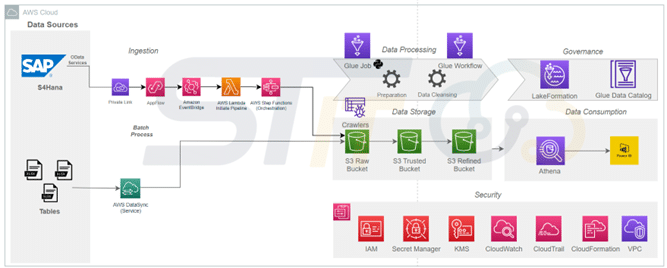
SAP data migration was performed using AWS AppFlow, which allowed efficient data transfer without manual intervention. Excel spreadsheets were also incorporated into the data flow, ensuring a unified and accurate view of the information.
2. Serverless Data Lake Creation
With data migrated to Amazon S3, the AWS platform provided a secure and scalable foundation for building a Serverless Data Lake, without the need to provision additional servers.
The use of Amazon Athena for fast and optimized queries eliminated infrastructure complexity, allowing data to be accessed efficiently.
3. Automation and Integration with BI Tools
One of the main advances after migration was the automation of data ingestion and transformation, which ensured continuous information updates in Power BI.
This enabled business teams to access real-time data, reducing dependence on manual processes and allowing faster, data-driven decisions.
Challenges Overcome in the Data Transition to AWS
During the migration process, integrating legacy systems such as SAP with the AWS platform represented one of the greatest challenges.
However, with meticulous planning and the use of the right tools, the team successfully carried out the integration effectively, ensuring secure and efficient communication between platforms.
Another significant challenge was standardizing data sources, which required rigorously reviewing data structures and implementing good governance practices.
The partnership between ST IT Cloud and the food industry's internal team was crucial for ensuring adherence to the project timeline and achievement of strategic objectives.
Results Achieved
After migrating to AWS, the food industry company experienced a significant transformation in how it managed and analyzed its data.
The migration to a Serverless Data Lake not only optimized data ingestion and analysis but also brought tangible benefits, such as:
- Greater Operational Efficiency: The automation of data ingestion and transformation processes eliminated manual handling, reducing errors and increasing information accuracy.
- Scalability: The solution implemented on AWS ensured that the data infrastructure could grow without impacting performance, allowing the company to handle increasingly larger data volumes.
- Reduction of Operational Costs: Eliminating the need for physical servers and using a serverless architecture resulted in a significant reduction in operational costs.
- More Agile Decisions: Integration with Business Intelligence tools provided a unified view of data, allowing the company to make faster decisions based on concrete data.
The Impact of Data Migration to AWS Cloud
Migration to the AWS cloud was a fundamental step for modernizing the food industry company's data infrastructure.
With the construction of a Serverless Data Lake and the automation of data ingestion, the company managed not only to optimize its data management but also to create a solid foundation for future innovations and the implementation of technologies such as Machine Learning and Generative AI.
This case highlights how migrating to AWS, when performed with the support of a specialized company like ST IT Cloud, can not only optimize data management but also provide a foundation for sustainable growth and continuous digital transformation.
If your company is considering migrating to the cloud, AWS offers scalable and secure solutions, and ST IT Cloud can help you navigate this process efficiently and aligned with your business objectives.