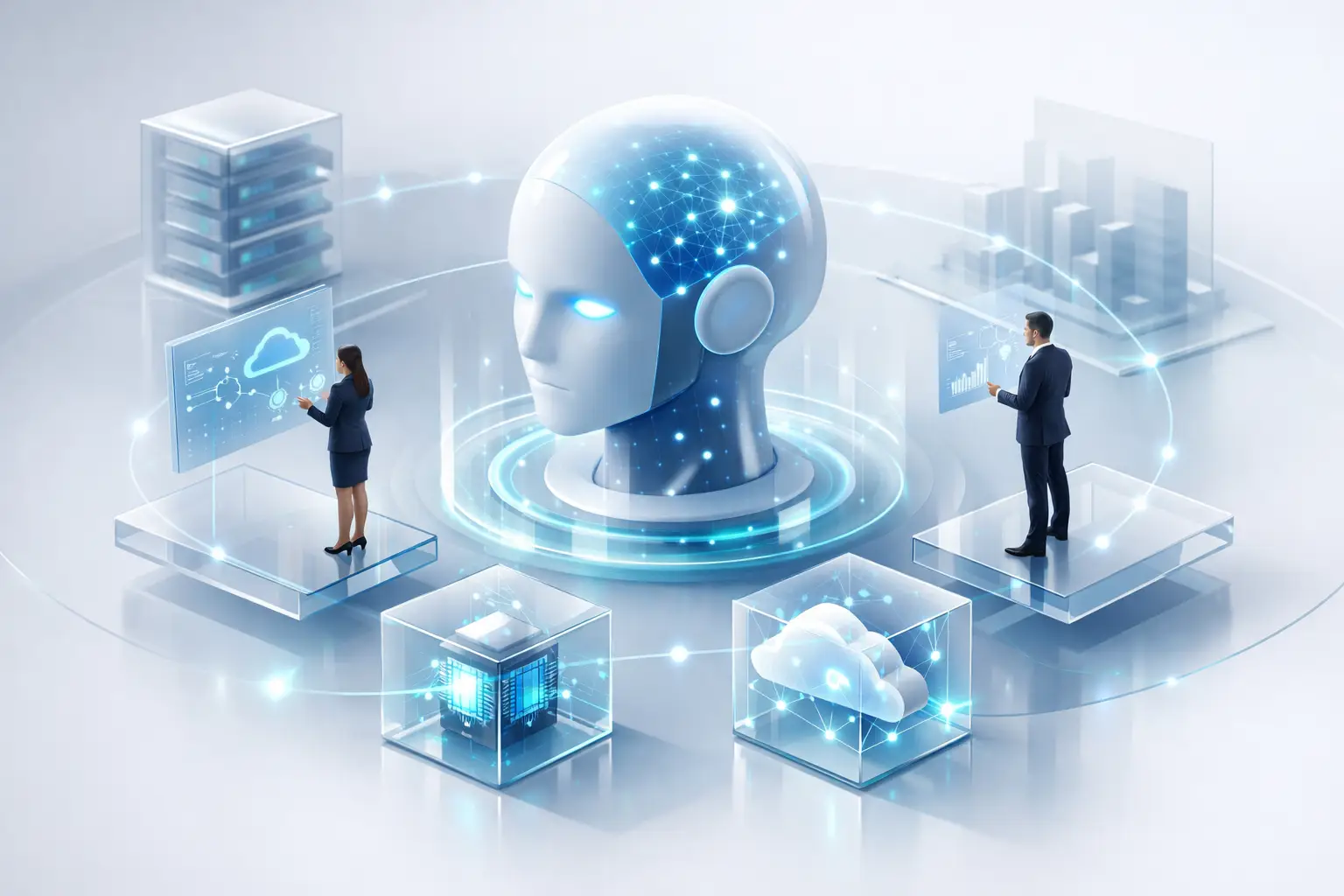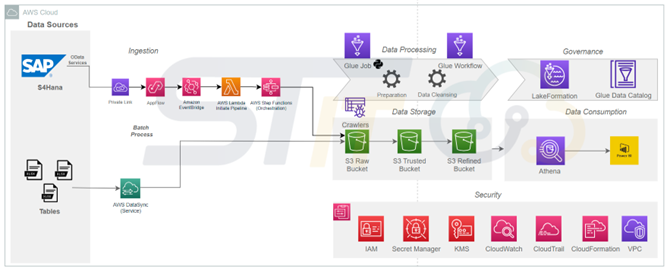
Currently, artificial intelligence can be understood as a strategic axis of corporate innovation.
However, the real value of AI lies not just in isolated models, but in the orchestration of AI models, which connects algorithms, data, intelligent agents, and processes in an integrated, scalable, and governed ecosystem.
Leading companies have already understood that innovating with AI requires more than experimenting with technologies: it requires architecture, integration, and strategic alignment.
In this new scenario, orchestration consolidates itself as the critical factor for transforming AI models into real value creation engines, enabling new products, services, and business solutions.
Throughout this article, you will understand how AI model orchestration drives innovation, what the main corporate use cases are, and how the expertise of ST IT Cloud, in partnership with AWS (Amazon Web Services), enables advanced Artificial Intelligence and Machine Learning projects at enterprise scale.
What is AI model orchestration and why is it decisive?
AI model orchestration refers to the intelligent coordination of multiple models, agents, data pipelines, legacy systems, and cloud services, in an integrated and automated manner.
Instead of operating AI solutions in isolation, organizations begin building architectures capable of:
- Chaining specialized models (e.g., NLP, computer vision, predictive and generative models);
- Integrating AI into corporate workflows;
- Managing governance, versioning, monitoring, and scalability;
- Connecting automated decisions to strategic business processes.
In practice, orchestration allows AI to act as a living system, capable of learning, adapting, and operating in a coordinated manner across different company areas.
According to an article published by Deloitte, the market for AI agents and orchestrated systems may reach US$35 billion by 2030, potentially reaching up to US$45 billion if companies can better orchestrate their agents and mitigate operational and scale risks.
This data reinforces a clear trend: AI innovation increasingly depends on the ability to integrate, coordinate, and govern multiple intelligent components.
From experimentation to strategy: the maturity of AI innovation
During the first adoption wave, many companies focused on proof of concepts and isolated applications.
Although important, these experiments frequently generated technology silos with low strategic impact.
Now, the market enters a more mature phase, where the creation of AI products and the transformation of corporate services require a broader architectural vision. This means:
- Defining use cases aligned with the business core;
- Integrating AI into critical processes (sales, operations, finance, supply chain, customer service);
- Creating continuous data and learning pipelines;
- Establishing governance, security, and compliance.
In this context, AI model orchestration becomes the link between technological innovation and strategic execution.
Orchestration and AI agents: the new engine of intelligent automation
One of the main catalysts of this transformation is the evolution of AI agents.
Unlike traditional models, agents are capable of executing tasks autonomously, making decisions, and interacting with other systems and agents.
An analysis published by Gartner predicts that by 2028, 33% of enterprise software applications will include AI agents, with at least 15% of daily work decisions being made autonomously.
However, the success of these agents depends directly on orchestration. Without an orchestrating layer, agents tend to operate in a fragmented manner, increasing risks, costs, and complexity.
Orchestration allows:
- Coordinating multiple agents with distinct functions;
- Defining prioritization and escalation rules;
- Integrating agents with corporate systems (ERP, CRM, BI, Data Lakes);
- Monitoring performance, security, and compliance.
Thus, the application of machine learning in enterprise solutions stops being merely technical and becomes structural, directly impacting the company's operating model.
AI product creation: from idea to market with speed
AI model orchestration also redefines how digital products are conceived, tested, and scaled. Instead of long, linear cycles, companies start operating with:
- Automated experimentation and validation pipelines;
- Continuous integration between user data and models;
- Dynamic functionality personalization;
- Rapid evolution based on real-time feedback.
This enables the creation of AI products that continuously learn, adjust to user behavior, and deliver incremental value more quickly.
For example, recommendation solutions, dynamic pricing, fraud detection, and personalization engines depend directly on the orchestration between multiple models, data sources, and business rules.
Corporate service transformation with orchestrated AI
In the field of corporate service transformation, orchestration significantly amplifies AI's impact.
Areas like customer service, financial back office, procurement, HR, and operations can be redesigned based on intelligent flows.
With orchestrated AI, it is possible to:
- Automate end-to-end processes;
- Integrate chatbots, agents, RPA, and predictive models;
- Create intelligent omnichannel journeys;
- Reduce response time and operational errors.
This level of integration transforms AI from a support tool into a central component of the service architecture.
Strategic integration: connecting AI to business objectives
One of the biggest mistakes in AI adoption is treating it as a purely technological project.
Innovation with AI only sustains itself when it is directly connected to the organization's strategic objectives and when it actually positively impacts the team's work processes.
AI model orchestration enables this connection by allowing automated decisions, advanced analyses, and intelligent agents to be integrated with KPIs, goals, and strategic processes.
This means AI stops being a "laboratory" and becomes a strategic execution engine, supporting: market expansion; structural cost reduction; improved customer experience; increased operational efficiency; and competitive differentiation.
Governance, security, and scalability: pillars of orchestration
As complexity increases, so does the need for governance structures. Orchestrating AI models requires rigorous control over:
- Model versioning;
- Performance and bias monitoring;
- Data security;
- Regulatory compliance;
- Observability of decision flows.
Also according to the previously mentioned Gartner research, more than 40% of agentic AI projects may be canceled by 2027 due to costs, complexity, and lack of adequate governance.
This data reinforces that orchestration is not only technical, but also organizational and strategic.
The role of ST IT Cloud and AWS in AI orchestration at scale
It is in this scenario that ST IT Cloud's expertise becomes decisive.
With strong performance in AWS architecture, data, Machine Learning, and corporate AI, the company supports organizations in building orchestrated, secure, and scalable ecosystems.
The partnership with AWS enables:
- Implementing modern data and AI architectures;
- Automating ML pipelines (MLOps);
- Integrating agents, models, and corporate systems;
- Ensuring elastic scalability and high availability;
- Applying end-to-end governance, security, and compliance.
This approach transforms AI projects into strategic platforms of continuous innovation, reducing risks and accelerating time-to-value.
AI model orchestration as a competitive differentiator
In an increasingly data-driven and intelligently automated market, the ability to orchestrate AI models becomes a real competitive differentiator.
Companies that master this layer can innovate faster; scale solutions with lower marginal cost; integrate AI into the business core; create smarter products and services; and respond nimbly to market changes.
More than adopting AI, it is about structuring intelligence as part of the business architecture.
The future of innovation runs through orchestration
The next frontier of corporate Artificial Intelligence lies not just in more powerful models, but in better orchestrated ecosystems.
AI model orchestration is what connects technology, data, processes, and strategy into a single system of continuous innovation.
Organizations that invest in this vision build a solid foundation to innovate products, transform services, and create business solutions with real impact, scalability, and governance.
Is your organization ready to elevate data maturity and accelerate Analytics, Machine Learning, and AI initiatives?
With ST IT Cloud's specialization in data architecture, AI, and ML on AWS, your company gains the technical, strategic, and operational foundation needed to transform artificial intelligence into real results — with scalability, governance, and end-to-end automation.
You might also like: