The evolution of artificial intelligence and advanced Analytics is redefining the role of data within organizations.
Today, data are not just operational inputs, but strategic assets that determine competitiveness, innovation, and decision-making speed.
In this context, the foundation of everything is not AI itself, but rather a modern cloud architecture capable of sustaining massive data volumes, complex integrations, and real-time analytical workloads.
Without this foundation, artificial intelligence initiatives tend to face bottlenecks, rework, and low scalability.
Companies wishing to evolve toward an AI at scale scenario on AWS need to go beyond simple cloud migration.
It is necessary to structure a data-oriented architecture, with governance, efficient integration, and elastic processing capacity. This is the starting point for transforming dispersed data into actionable intelligence.
Modern cloud architecture as the foundation for the future of AI
Adopting a modern cloud architecture represents a structural change in how companies deal with data and analytical applications.
Instead of rigid and isolated environments, the modern model prioritizes decoupling, automation, and native scalability.
In practice, this means data flows continuously between systems, is processed in different layers, and remains available for Analytics and AI consumption.
This approach is essential in a scenario where generative artificial intelligence and predictive models require large volumes of reliable and updated data.
Furthermore, according to recent market trends released by Gartner, organizations are evolving from a "single source of truth" model to a "sea of trust", in which different data layers coexist with governance and traceability.
This evolution is only possible with a well-structured cloud foundation, which allows integration, control, and data consistency throughout the entire analytical ecosystem.
From chaos to managed complexity: the new data paradigm
As organizations mature in data, the challenge stops being just storage and becomes managing complexity.
Many companies live in a scenario where multiple sources, pipelines, and tools create a fragmented environment.
This is where modern cloud architecture becomes essential, as it allows transforming operational chaos into managed complexity — connecting data from different areas into an integrated ecosystem.
This movement also reflects a mindset shift: data should not just be centralized, but organized intelligently for different uses — from operational reports to advanced AI models.
Furthermore, companies that adopt a structured approach can reduce redundancies, improve information reliability, and accelerate decision cycles.
Complexity continues to exist, but is now understood, governed, and strategically explored.
Data Lake on AWS and data integration as fundamental pillars
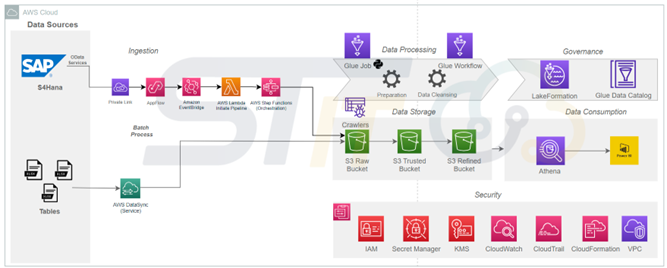
One of the central components of modern cloud architecture is the Data Lake on AWS, which allows storing large volumes of structured and unstructured data at scale, serving as the foundation for Analytics and Machine Learning.
On AWS, this architecture typically involves services such as scalable storage, distributed processing, and cataloging and governance tools.
The goal is not just to store data, but to ensure they can be easily accessed and used by different teams.
However, the value of the Data Lake depends directly on the quality of data integration.
Without efficient integration, the Data Lake becomes just a disorganized repository.
Therefore, mature companies invest in well-defined data pipelines, capable of collecting, transforming, and distributing information continuously.
This integration allows eliminating silos, increasing data consistency, and creating a reliable foundation for advanced Analytics and AI.
Cloud infrastructure scalability for advanced Analytics
One of the main differentiators of the cloud is the capacity to scale resources on demand. Cloud infrastructure scalability allows companies to process large data volumes without compromising performance or costs.
In the context of advanced Analytics, this is essential. Complex queries, real-time data processing, and machine learning models require elastic infrastructure, capable of dynamically adapting to workload.
Modern architecture on AWS enables this behavior through decoupled services and serverless models, reducing the need for manual infrastructure management. This not only improves operational efficiency, but also accelerates insight delivery.
Furthermore, scalability ensures the organization is prepared for future growth, avoiding expensive and complex restructuring when data volume increases.
AI preparation: reliable data and data-oriented architecture
AI preparation does not start with algorithms, but with data. Artificial intelligence models are highly dependent on the quality, consistency, and availability of information used in training.
Therefore, a data-oriented architecture is fundamental, as it ensures data is collected, treated, and made available in a structured manner, with governance and traceability.
In this scenario, concepts such as data quality, lineage, and observability become indispensable.
Without them, AI models can generate inconsistent or biased responses, compromising strategic decisions.
Another critical point is the data lifecycle. In mature environments, data is continuously validated, updated, and monitored, ensuring it remains relevant for analytical applications and AI models.
Data-oriented architecture as competitive advantage
Companies that adopt a data-oriented architecture can transform information into real competitive advantage.
This happens because decisions stop being based on intuition and begin to be guided by concrete evidence.
Furthermore, this approach allows greater alignment between business areas, technology, and data, creating a more collaborative and efficient ecosystem.
Another relevant point is the democratization of information access. When well structured, architecture allows different areas of the company to use data safely and reliably, which reduces dependence on technical teams for insight generation.
This movement is directly related to a cultural shift: moving from operational overload and evolving toward a data and intelligence-driven organization.
The role of ST IT Cloud in building modern architectures on AWS
In this transformation scenario, consultative action becomes as important as the technology itself.
ST IT Cloud operates precisely in the design and evolution of modern data architectures on AWS, supporting companies in building scalable, secure environments prepared for AI.
The work goes beyond technical implementation. It involves maturity diagnosis, architecture definition, Data Lake structuring, data integration, and continuous performance optimization.
This model ensures the organization not only adopts modern technologies, but builds a solid foundation for sustainable growth in Analytics and artificial intelligence.
By combining good architecture, governance, and scalability practices, the company helps organizations avoid rework, reduce costs, and accelerate their data journey.
Data architecture as the foundation for continuous innovation in the cloud
Building a modern cloud architecture is an indispensable step for companies that wish to evolve in advanced Analytics and AI at scale.
More than a technological choice, it is a strategic decision that directly impacts the capacity for innovation and competitiveness.
Elements such as Data Lake on AWS, data integration, cloud infrastructure scalability, and a strong data-oriented architecture form the foundation of this new scenario.
As artificial intelligence becomes a central part of business operations, organizations that invest in a solid data foundation will be more prepared to innovate, scale, and compete in an increasingly information-driven environment.
In this context, it is worth reflecting that the process is not just about adopting technologies, but about building a structure capable of evolving sustainably with the business.
Is your organization ready to evolve in advanced Analytics and strengthen its AI preparation at scale?
With ST IT Cloud's expertise in data architecture on AWS, your company builds a solid foundation for Data Lakes and data integration.
This enables real-time dashboards, advanced analyses, and AI with security, scalability, and end-to-end control.
You might also like:
Orchestrating AI to innovate products, services, and business solutions
How to ensure compliance and efficiency in corporate cloud environments?